
Insights
Harness AI in Supply Chain: Br8kthru’s 3-Step Approach
“What, exactly, is AI?” “How can I best use AI in my workflows?” “What do I need to know about AI?” These are just some of the questions we hear from Clients about artificial intelligence, machine learning, and large language models.
As with any significant transformative tool or technology, AI is what you make of it. By embracing it, you can gain a competitive advantage and improve customer experience, while ignoring it could negatively impact your business.
Artificial Intelligence: A Tool in the Toolbox
First, what exactly is AI? AI, or artificial intelligence, is “technology that enables computers and machines to simulate human intelligence and problem-solving capabilities.”
AI can do various tasks that used to be manual and can be widely helpful throughout organizations and industries, making it something of a Swiss Army knife of technology. Despite its many uses, AI is just a tool in the toolbox, not the entire toolbox. Continue leaning on your team, peers, and existing tools as you begin or advance in your AI journey.
The AI Revolution: Reinvention as a Strategy for Business Success
As you embark on or continue your AI journey, it’s essential to be aware of the impact of AI on business today — and tomorrow. The AI revolution is not your average technology revolution.
“For many companies, the next 12 to 24 months will be a moment of truth: Among those who have invested in new technologies, skills and ways of working, return on those investments has varied. The advent of generative AI presents businesses with unparalleled potential to leapfrog their competitors” (Accenture).
The State of AI in Supply Chain
In the ever-evolving supply chain management landscape, the integration of artificial intelligence (AI) is revolutionizing operations, offering a glimpse into this critical industry's current state and promising future. AI currently empowers organizations with unprecedented insights and capabilities, driving efficiencies and enabling more informed decision-making across the supply chain.
- AI-powered predictive analytics enable more accurate demand forecasting, inventory optimization, and disruption anticipation, facilitating informed decision-making and cost reduction.
- Real-time supply chain visibility tools driven by AI offer insights into inventory, shipments, and production processes, enhancing efficiency and identifying bottlenecks swiftly.
- Automation through AI and robotics streamlines warehouse operations, reducing errors and labor costs while increasing productivity.
- AI optimization algorithms improve route planning, transportation scheduling, and network design, optimizing efficiency and cost-effectiveness.
Embracing the Future of AI in Supply Chain
At Br8kthru, we believe in the power of AI to create new value and proactively change operations and customer experience. However, organizations must be ready to capture the generative AI opportunity without underestimating how this technology will upend their industry and competitive advantage.
AI will revolutionize your business if you let it. Those who are equipped to reinvent themselves using AI will be in a better position to succeed over time than those who are not.
Br8kthru’s Framework for Approaching AI
As with any significant change, adopting AI is more accessible with a framework to approach the change. At Br8kthru, we have a simple three-step approach to approaching an AI implementation plan to help you build a roadmap to success.
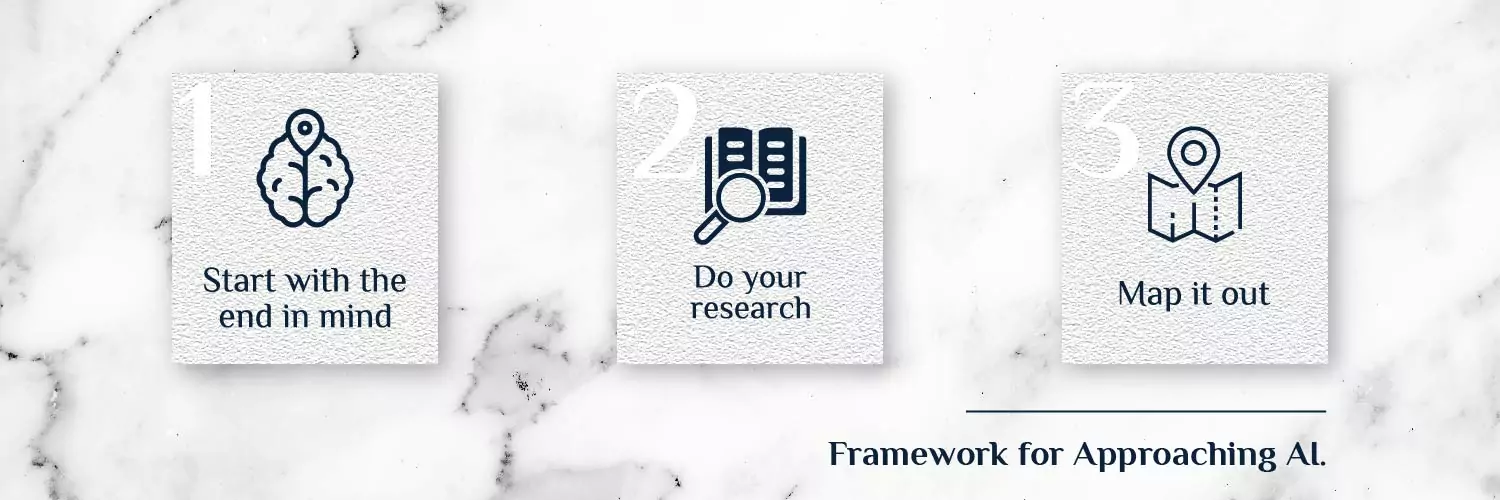
Keep in mind, making a digital transformation like the adoption of AI isn’t just a one- or two-year process; it needs to be an iterative loop that gets embedded into your workflows. By integrating AI into your workflows and adopting it entirely, you can more completely reap the benefits of using the tools.
Start with the End in Mind
“The Five Whys” is an iterative approach to understanding the underlying cause and effect of specific problems. By asking yourself “why” multiple times over, you can get to the root of a problem and best understand it. In essence, any successful AI adoption starts with the “why” and a clear problem statement to center on. (Hint: You can even have AI help you craft a successful problem statement.)
Do Your Research
After determining what you want to use the technology for, comprehensively research your options. From online research of your own to checking in with vendors and industry association partners, you can build a better understanding of what tools are available, what you need, and what might fit your needs. Whatever you choose, you’ll want tools and technologies that are stable, secure, and can support the scalability that you’re looking for.
Map It Out
Once you’ve decided on a tool — or suite of tools — begin mapping out your strategy for adoption. This can look any number of ways, depending on your organization and resources. Still, the important thing is that at least one person takes ownership of and accountability for an implementation plan. That way, you’ll be able to share what you’re going to do, execute on it, and then remind others of what you’ve done.
This three-step framework is the simplest way we’ve found to approach AI adoption in a business setting, and we’ve seen it works for Clients of all business sizes across industries.
Once you’ve created your adoption plan, it’s time to begin incorporating AI into existing workflows — and creating new ones. We discussed some practical applications of AI for businesses in the manufacturing and distribution space.
Practical Applications of AI in Supply Chain and Operations
In our research, approximately 60% of supply chain and operations leaders report they are relatively new to AI and its potential applications in their work, individually or organizationally. With so much opportunity in the AI space, new doors are opening for the adoption and acceleration of AI.

While adopting AI tools into existing workflows can feel daunting, the easiest way to start is at the beginning. Start with something low-stakes to get your bearings and continue to explore and adapt as needed. Consider having AI help you draft an email or pick a wine pairing for dinner.
Then, apply AI tools in your daily work and investigate other applications; understand the tools at your disposal and when they best suit your needs. Knowing when not to use AI is just as important as knowing when it can be helpful. Once you’ve experimented, build a portfolio of AI tools you’re willing and able to use in your work.
This slow, steady approach to adoption enables you to get better at using the tools and prompting them more effectively.
Once you’re ready to move from the foundations to more accelerated opportunities, there are myriad ways to engage with AI, especially in manufacturing and distribution.
For example, AI can support optical character recognition, or reading data from one source and transferring it to another. A commodities trader and manufacturer uses this to read purchase orders, understand different fields, extract the data, and enter it into the purchasing system.
In another example, AI supports a manufacturer in filling drums with product. The company used machine visioning to train the AI on the size of the drums, where the openings were, and how much product could be inserted into the drum before being full. Now, the drums can be filled autonomously.
Regardless of how you use it, AI should be a tool in your technology stack; incorporating AI into existing workflows and creating new workflows with AI is vital to staying competitive.
Adopt AI for Long-Term Success
No matter how you choose to use AI in your supply chain and operations work, the important thing is that you use it. AI is revolutionizing business as we know it, and those who use it to reinvent their businesses will be at the forefront of success in the coming months and years. For more information and guidance with your AI strategy as you begin or advance your AI in supply chain journey, contact Br8kthru.