
Insights
Google has indicated it would be phasing out third-party cookies for years. Despite delays in the process, the day has come. Last month, Google introduced “Tracking Protection” for about 1% of Chrome users — or an estimated 30 million people.

Understand the Privacy Sandbox
This change comes as part of Google’s Privacy Sandbox initiative, which “aims to create technologies that both protect people's privacy online and give companies and developers tools to build thriving digital businesses.”
Essentially, Google plans to reduce cross-site and cross-app tracking to protect users while keeping content online accessible.
Exactly what this means remains to be seen, as the Privacy Sandbox is “still in development,” but Google Tracking Protection is understood to be a significant aspect of the Privacy Sandbox to date.
The Role of Third-Party Cookies
Online, cookies are used to track user behavior. First-party cookies are from the site you’re using and monitor your activity and preferences for future visits. Third-party cookies, on the other hand, are attached by other websites and track personal information and browsing data; they’re often used for targeted advertising. Overall, cookies have plenty of utility in how we browse the web. The concern right now is how they impact data privacy.
As Google puts it, “third-party cookies have been a fundamental part of the web for nearly three decades.” Because they’re so widespread and used for many purposes, they’re challenging to replace. There are potential substitutes available, but none are as ubiquitous as cookies.
Google is proposing sharing anonymized user browsing data with advertisers, who can then use Google-provided APIs to target ads while protecting user privacy.
The Cookieless Future is Now
Of course, Google Chrome is not the only browser we have available to us. What about other browsers, like Firefox or Safari? In short, they’ve been blocking third-party cookies for some time now. Chrome is, in many ways, behind the curve on this front. However, Chrome is the dominant browser in the market, representing an estimated 64% of internet users, meaning the world is watching as it sets the stage for a true cookieless future.
How to Respond: Google Tracking Protection
The January update for 1% of Chrome users is simply a trial run so “developers can test their readiness for a web without third-party cookies.” Expect Google Tracking Protection to roll out to all users in the second half of 2024.
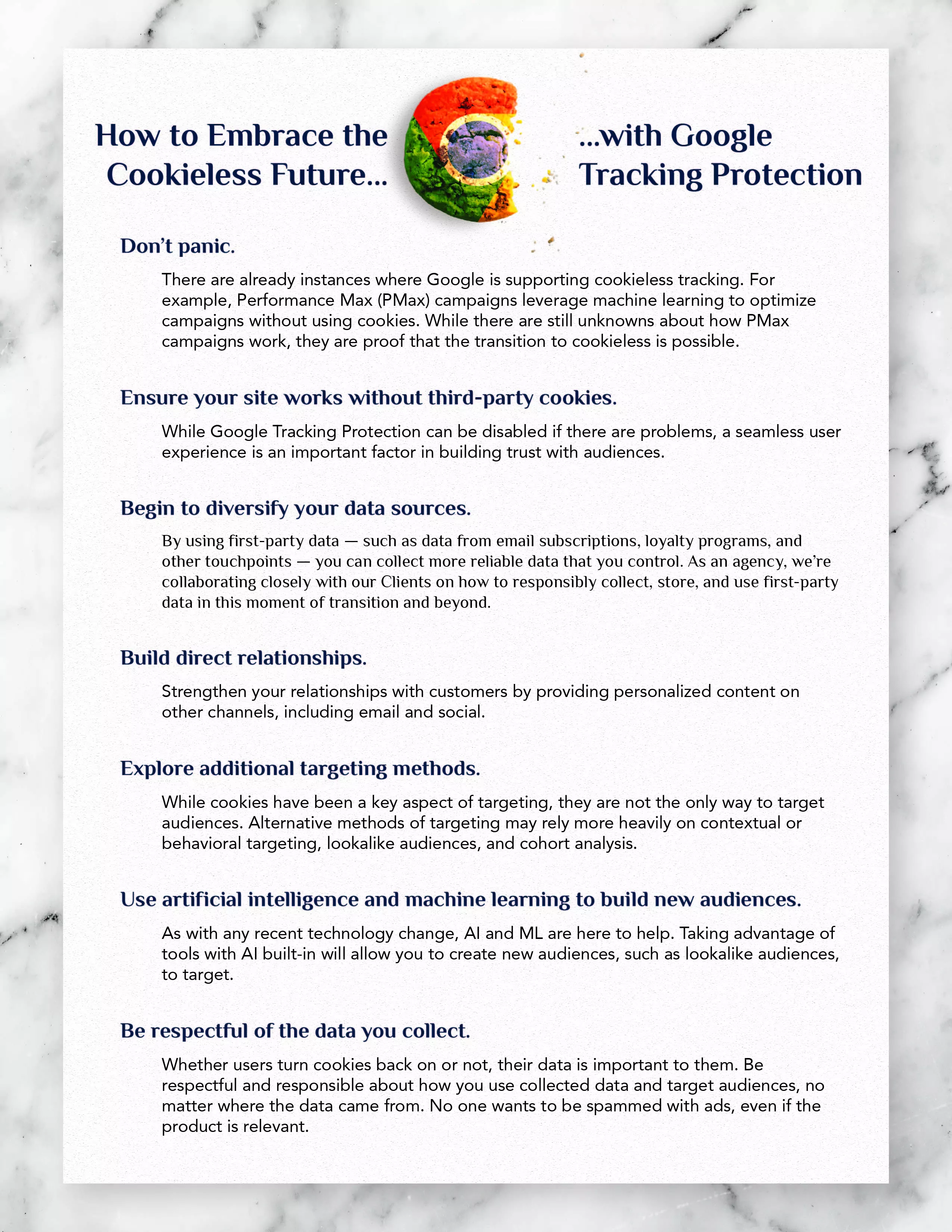
In order to prepare, marketers should do the following:
- Don’t panic. There are already instances where Google is supporting cookieless tracking. For example, Performance Max (PMax) campaigns leverage machine learning to optimize campaigns without using cookies. While there are still unknowns about how PMax campaigns work, they are proof that the transition to cookieless is possible.
- Ensure your site works without third-party cookies. While Google Tracking Protection can be disabled if there are problems, a seamless user experience is an important factor in building trust with audiences.
- Begin to diversify your data sources. By using first-party data — such as data from email subscriptions, loyalty programs, and other touchpoints — you can collect more reliable data that you control. As an agency, we’re collaborating closely with our Clients on how to responsibly collect, store, and use first-party data in this moment of transition and beyond.
- Build direct relationships. Strengthen your relationships with customers by providing personalized content on other channels, including email and social.
- Explore additional targeting methods. While cookies have been a key aspect of targeting, they are not the only way to target audiences. Alternative methods of targeting may rely more heavily on contextual or behavioral targeting, lookalike audiences, and cohort analysis.
- Use artificial intelligence and machine learning to build new audiences. As with any recent technology change, AI and ML are here to help. Taking advantage of tools with AI built-in will allow you to create new audiences, such as lookalike audiences, to target.
- Be respectful of the data you collect. Whether users turn cookies back on or not, their data is important to them. Be respectful and responsible about how you use collected data and target audiences, no matter where the data came from. No one wants to be spammed with ads, even if the product is relevant.
No matter what you do, we recommend testing it now, just in case you encounter roadblocks. Proactivity and flexibility will be key components of a successful transition.
Going cookieless, while challenging, is not impossible. You and your team can readily adapt to the Chrome change by implementing the above suggestions.
Go Cookieless with Br8kthru’s SMEs
The cookieless future, once distant, is a reality for some today and many more soon. This change could be disruptive or an opportunity to rethink your marketing strategy to be more responsive to the realities of today’s landscape.
At Br8kthru, our subject matter experts (SMEs) are adept at staying up to date on the latest trends and best practices, and can guide you and your team as you make the switch to cookieless.